WILSONELECTRONICS.COM, WILSONPRO.COM AND ZINWAVE.COM ARE NOW WILSONCONNECTIVITY.COM
Your Complete Guide to Distrbuted Antenna Systems (DAS)
June 6, 2024
For larger buildings and campuses, a Distributed Antenna System (DAS) might be the ideal solution for consistent cell signal coverage. But what exactly is DAS, and how do you know if it’s right for your unique facility? This comprehensive guide walks you through everything from basic concepts to implementation strategies.
DAS addresses cellular connectivity problems for both large and small spaces in outdoor and indoor venues. In fact, despite the perception that DAS is designed only for arenas, stadiums, airports, hospitals, and other massive places, 90% of the DAS system cellular solutions in use today are primarily used in smaller spaces.
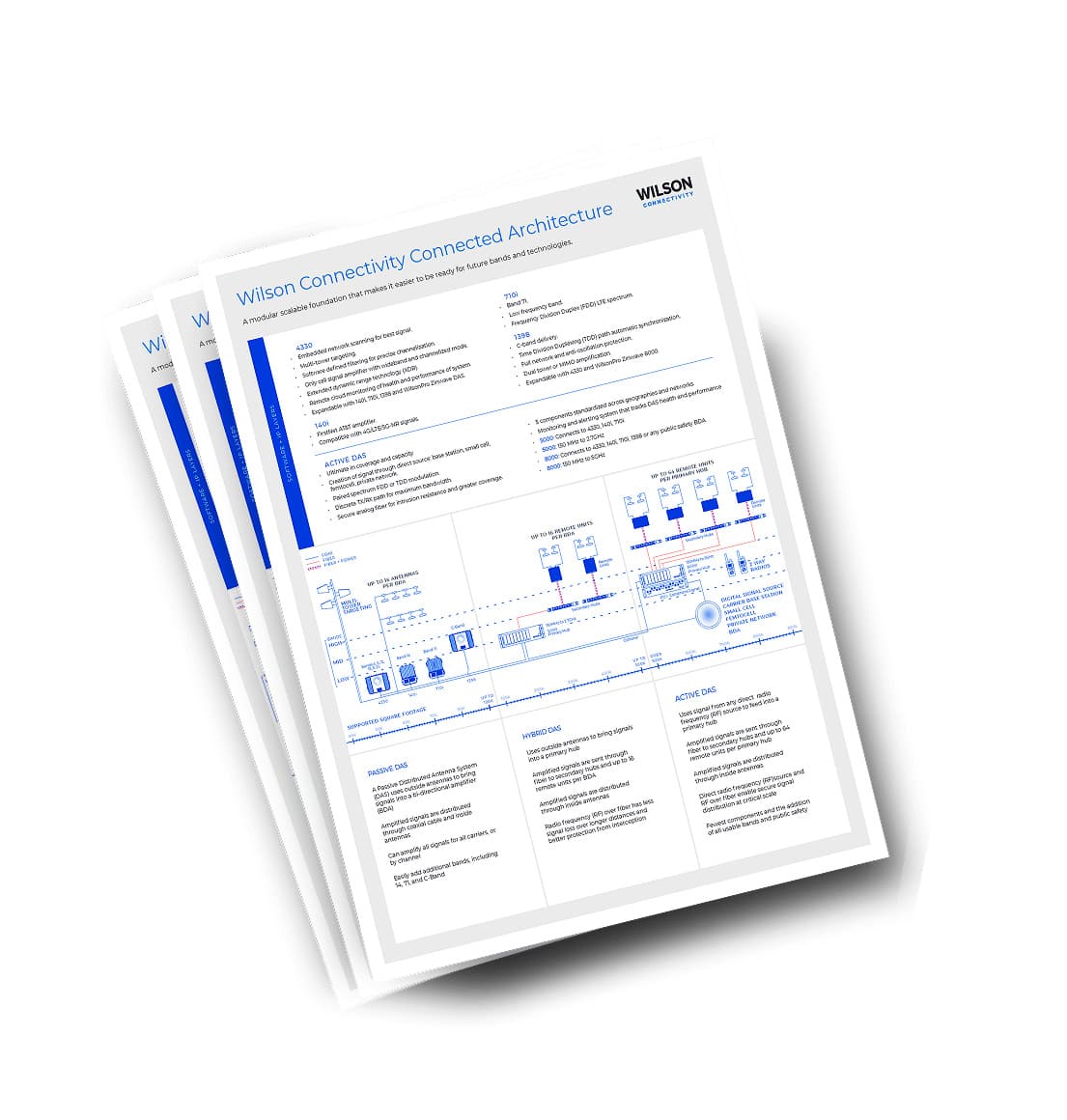
DAS systems can be classified as active, passive, or hybrid. The right system for the connectivity issues a client is facing, depends on a number of factors such as: strength of existing signal, number of users, areas of coverage needed, building layout and materials and existing infrastructure.
An active DAS system creates cellular signal to provide coverage and is best for buildings over 500k square feet. The system distributes signal from any direct radio frequency (RF) source including carrier base, femtocell, small cell, BDA, private networks to remote DAS nodes placed around a building. Active DAS from Wilson covers frequencies from 150 MHz to 5 GHz on a single system to handle everything from public carrier networks and public safety to two-way radios.
Active DAS systems offer the highest level of security, relying on direct wired connections and RF over fiber to deliver network data and device connectivity with greater protection against interception.
The hardware and installation requirements of a passive DAS system are less expensive and can be installed faster than what’s required for active DAS systems:
Passive DAS conforms to FCC regulations and generally does not require outside regulatory approval. Since most systems are pre-approved, and because of the low infrastructure requirements for installation, passive DAS can be installed in a matter of days.
With less overhead and equipment than other options, passive DAS is a financially viable option for a wide range of users. Costs for hardware and installation of passive DAS start at $1 per square foot. Plus, most passive DAS systems are carrier-agnostic and support multiple carriers simultaneously. So, whether your clients use major carriers like AT&T, T-Mobile and Verizon, or smaller regional carriers, a passive DAS ensures everyone gets the same amplified signal.
What is hybrid DAS?
A hybrid distributed antenna system (DAS) bridges the gap between passive and active DAS, combining the strengths of both approaches into a scalable solution. It’s designed for facilities that need more than a passive DAS system but don’t require the full cost or complexity of a traditional active DAS.
A hybrid DAS uses a mix of passive components and fiber optic cable to distribute signal efficiently across medium to large buildings, typically from 100,000 to 500,000 square feet. The system receives signal from a direct RF source, such as a carrier base station, small cell, BDA, or private network, then converts and transports that signal over fiber to remote hubs. From there, passive coaxial cabling and antennas deliver coverage throughout the building.
This architecture allows hybrid DAS to extend coverage farther than passive DAS while remaining more cost-effective and simpler to deploy than a fully active DAS. Wilson Connectivity hybrid DAS solutions support a wide range of frequencies, enabling coverage for public carrier networks, private cellular, public safety, and other critical wireless services on a single system.
Hybrid DAS also offers improved security and performance compared to purely passive systems. By leveraging RF over fiber for signal transport and reducing long coaxial runs, hybrid DAS minimizes signal loss and provides greater resistance to interference or interception, making it an ideal solution for growing enterprises, campuses, and complex indoor environments that need room to scale.
What’s more, retail cell phone booster solutions like passive DAS enhance security and point-of-sale reliability. Think about how retailers can lose sales due to a slow or unresponsive system, and the associated lines and waiting. Additionally, lack of a secure internet connection can hinder credit card validation and increase fraud rates. A cellular backup can both alleviate these concerns and reduce costs over solely using a fixed line connection.
Designed to serve multiple carriers, DAS provides developers a connectivity solution that meets the needs of all of their tenants, regardless of what cellular provider they use. Additionally, the affordability and simplified installation with DAS helps developers meet their obligations when it comes to their bottom line.
Unfortunately, hospital cellular signals are easily overwhelmed by staff, patients, and visitors, or negatively impacted by building materials like brick, concrete, steel, and glass. When doctors, nurses, and other caregivers can’t connect with one another, patient care suffers. That’s where DAS comes in.
With hospital budgets under scrutiny, administrators increasingly look for ways to lower costs while still prioritizing quality care. DAS offers a cellular connectivity solution for hospitals with the added benefits of skilled integrators trained in clean installs.
DAS systems provide an event cellular connectivity solution and have been deployed with great success at New York Fashion Week and other events. Integrators can help event coordinators check off the cellular connectivity box on their planning checklist.
Business travelers need to check email and make work calls from their cell phones, and leisure travelers need to check in at home, read up on local restaurants, and more. Plenty of hotels offer Wi-Fi, but without a strong hotel cellular signal to supplement it, guests may as well be living off the grid.
DAS is an ideal connectivity solution for hotel developers and IT managers. Whether the hotel is under construction or up and running, DAS enhances cellular service for guests.
When emergency medical teams and public safety officers have access to a strong signal on their communication channels, they are better equipped to use location services and maps, and communicate with one another to do their jobs more effectively. Hybrid DAS helps improve access in public and government buildings. With a DAS system in place, the improved connection results in safer, more efficient operations and enhanced public safety. Even in existing buildings a DAS system can be retrofitted to enable public safety communication.
Work with a Dedicated IntegratorYour Wilson Connectivity authorized representative can discuss your cellular connectivity needs with you and get you on the path to your cellular amplifier installation in your building. They’ll start by referring you to a Wilson Connectivity certified integrator in your area. This professional has a deep working knowledge of the different products that can improve signal inside of buildings and how they can be used.
Get a Site SurveyOnce you’ve completed this initial exploratory conversation, your integrator will schedule a site survey at your building. A site survey is the first and most crucial step in assessing your cellular signal amplification needs to ensure you receive the best solution.
Design your Customized SolutionOnce the initial consultation and site signal survey are complete, your integrator will put together a customized installation plan based on your specific needs, building size, and outside signal strength.
Remote MonitoringTo ensure the optimal performance of your cellular signal amplification system, your Wilson Connectivity integrator will offer maintenance and support for any new or future needs or problems. Remote monitoring is part of all Wilson Connectivity DAS systems. These cloud-enabled systems alert customers of any changes or issues so the integrator can be notified and make adjustments to the amplifier for optimal performance.
Download the Wilson Connectivity In-Building DAS Installation Guide to learn more about what to expect.Wilson Connectivity Cellular Passive DAS Case
Here are some benefits of a cellular DAS solution with real-life scenarios where the technology has been deployed and achieved desired outcomes.
Construction was well underway by the time officials realized the problem. Strong cellular connectivity was vital for both sales associates who handled on-the-spot customer checkout, and shoppers who needed the ability to call, text, and access data while inside the store.
The business needed a timely solution that would fit strict design specifications of the remodeled store, so the IT manager contacted a Wilson Connectivit certified integrator. The integrator immediately knew a passive DAS was the right solution. The system required multiple boosters designed for large commercial spaces to generate seamless cellular coverage and data transfer capability. They recommended Wilson Connectivity signal boosters for the job.
System installation was completed in only four days, just as the department store opened its doors. By the time customers began shopping, they could send and receive phone calls, texts, and access cellular data from every floor without a problem. Store clerks used their tablets to access the network for faster customer service and sales processing. For more about this success story, read the case study.
That problem became apparent during the recent construction of a condominium in downtown Montreal. As the grand opening neared, developers noticed that the building’s key systems were not functioning due to lack of cellular service. The glass windows and doors that covered the building interfered with the signal that drove the building’s intercom, security, and elevator telephone systems, even though the antennas operating those systems were located just a few feet from the glass doors. When the lobby doors were open, the cellular signal was a strong -60 decibels, but as soon as it closed, the signal fell dramatically to -120 decibels.
With little time to waste before the opening, building developers and Bell Canada contacted Stephen Friedman, vice president and chief operating officer of Wilson Connectiviy integrator, Cellworx. It was soon clear to Friedman that the building required a passive DAS to enhance the cell signal inside the building.
After installation, all systems inside the building were up and running with improved cell signal in time for the opening. Passive DAS enhanced the signal inside the building to approximately -50db, far improved from the -120db the lobby received before the project began. To learn more, read the case study.
What are distributed antenna systems (DAS system)?
Using cell phones for both personal and business purposes, consumers have come to expect five-bar, reliable service. Fortunately, cellular network engineers have developed numerous solutions to meet modern cellular connectivity needs. Whether in remote areas or inside structures made of signal-sapping building materials, there are a variety of choices to improve cell signal and decrease dropped calls. Passive, hybrid and active distributed antenna systems (DAS) are the most popular go-to solutions.DAS addresses cellular connectivity problems for both large and small spaces in outdoor and indoor venues. In fact, despite the perception that DAS is designed only for arenas, stadiums, airports, hospitals, and other massive places, 90% of the DAS system cellular solutions in use today are primarily used in smaller spaces.
How do distributed antenna systems work?
A distributed antenna system (DAS), sometimes called a distributive antenna system, enhances cellular wireless signal with the installation of antennas and other components.DAS systems can be classified as active, passive, or hybrid. The right system for the connectivity issues a client is facing, depends on a number of factors such as: strength of existing signal, number of users, areas of coverage needed, building layout and materials and existing infrastructure.
What is the difference between passive, hybrid and active DAS?
While integrators typically understand the difference between passive, hybrid and active DAS, it can be challenging to explain to customers which one is the better choice. The following sections outline the differences and benefits of each solution.What is active DAS?
An active distributed antenna system (DAS) is a robust, infrastructure-intensive cellular connectivity solution for large areas. It’s commonly the first solution integrators and users turn to – but is it always the best option?An active DAS system creates cellular signal to provide coverage and is best for buildings over 500k square feet. The system distributes signal from any direct radio frequency (RF) source including carrier base, femtocell, small cell, BDA, private networks to remote DAS nodes placed around a building. Active DAS from Wilson covers frequencies from 150 MHz to 5 GHz on a single system to handle everything from public carrier networks and public safety to two-way radios.
Active DAS systems offer the highest level of security, relying on direct wired connections and RF over fiber to deliver network data and device connectivity with greater protection against interception.
What is passive DAS?
A passive distributed antenna system (DAS), also known as a cell phone signal booster system or in building repeater, eliminates cellular connectivity problems by enhancing existing cell signal up to 32 times. Unlike active DAS, it does not require new signal to be created.The hardware and installation requirements of a passive DAS system are less expensive and can be installed faster than what’s required for active DAS systems:
- Donor antennas installed on the roof bring in the outdoor signal.
- Broadcast or “inside” antennas on the interior wall (panel antennas) or ceiling (dome or low-profile antennas) then transmit the amplified signal to phones and other cellular devices indoors.
- Both types of DAS antennas connect to the amplifier unit via coaxial cable.
Passive DAS conforms to FCC regulations and generally does not require outside regulatory approval. Since most systems are pre-approved, and because of the low infrastructure requirements for installation, passive DAS can be installed in a matter of days.
With less overhead and equipment than other options, passive DAS is a financially viable option for a wide range of users. Costs for hardware and installation of passive DAS start at $1 per square foot. Plus, most passive DAS systems are carrier-agnostic and support multiple carriers simultaneously. So, whether your clients use major carriers like AT&T, T-Mobile and Verizon, or smaller regional carriers, a passive DAS ensures everyone gets the same amplified signal.
What is hybrid DAS?
A hybrid distributed antenna system (DAS) bridges the gap between passive and active DAS, combining the strengths of both approaches into a scalable solution. It’s designed for facilities that need more than a passive DAS system but don’t require the full cost or complexity of a traditional active DAS.A hybrid DAS uses a mix of passive components and fiber optic cable to distribute signal efficiently across medium to large buildings, typically from 100,000 to 500,000 square feet. The system receives signal from a direct RF source, such as a carrier base station, small cell, BDA, or private network, then converts and transports that signal over fiber to remote hubs. From there, passive coaxial cabling and antennas deliver coverage throughout the building.
This architecture allows hybrid DAS to extend coverage farther than passive DAS while remaining more cost-effective and simpler to deploy than a fully active DAS. Wilson Connectivity hybrid DAS solutions support a wide range of frequencies, enabling coverage for public carrier networks, private cellular, public safety, and other critical wireless services on a single system.
Hybrid DAS also offers improved security and performance compared to purely passive systems. By leveraging RF over fiber for signal transport and reducing long coaxial runs, hybrid DAS minimizes signal loss and provides greater resistance to interference or interception, making it an ideal solution for growing enterprises, campuses, and complex indoor environments that need room to scale.
How DAS Systems are Applied in Different Venues
DAS is a viable option regardless of the size or type of business. It can be effectively deployed in industries spanning retail, hospitality, restaurants, medical facilities, commercial offices and more. DAS is a feasible, effective solution for any indoor as well as outdoor situation.How DAS Works for Retail
Retailers prioritize customer engagement and the in-store shopping experience. Increasingly, this includes providing strong connectivity in the store to allow shoppers easy access to the internet and coupon apps. A DAS system enhances retail connectivity inside retail spaces, regardless of patrons’ cellular providers. With DAS, all carriers are supported.What’s more, retail cell phone booster solutions like passive DAS enhance security and point-of-sale reliability. Think about how retailers can lose sales due to a slow or unresponsive system, and the associated lines and waiting. Additionally, lack of a secure internet connection can hinder credit card validation and increase fraud rates. A cellular backup can both alleviate these concerns and reduce costs over solely using a fixed line connection.
How DAS Works for Commercial Real Estate
Despite being situated within range of multiple cellular towers, buildings located in crowded urban environments often suffer from poor cellular connection. This problem frustrates even the most experienced commercial real estate developers and can often be attributed to new, energy-efficient building materials that sap even the strongest cellular signals. Integrators can offer a DAS commercial real estate cellular solution.Designed to serve multiple carriers, DAS provides developers a connectivity solution that meets the needs of all of their tenants, regardless of what cellular provider they use. Additionally, the affordability and simplified installation with DAS helps developers meet their obligations when it comes to their bottom line.
How DAS Works for Hospitals
Hospitals and other medical facilities increasingly rely on cell phones and wireless devices for in-house communication, providing doctors and caregivers consistent cellular and data signal.Unfortunately, hospital cellular signals are easily overwhelmed by staff, patients, and visitors, or negatively impacted by building materials like brick, concrete, steel, and glass. When doctors, nurses, and other caregivers can’t connect with one another, patient care suffers. That’s where DAS comes in.
With hospital budgets under scrutiny, administrators increasingly look for ways to lower costs while still prioritizing quality care. DAS offers a cellular connectivity solution for hospitals with the added benefits of skilled integrators trained in clean installs.
How DAS Works for Live Events
Modern event spaces need robust cellular signal whether hosting local weddings and parties or large-scale events like the Grammys. Live tweeting, streaming, and Instagramming are critical to an event’s success. But without a strong, carrier-agnostic cellular and data connection, real-time social media networking is virtually impossible.DAS systems provide an event cellular connectivity solution and have been deployed with great success at New York Fashion Week and other events. Integrators can help event coordinators check off the cellular connectivity box on their planning checklist.
How DAS Works for Hotels
Hotel guests’ demands used to be relatively simple: a comfortable bed, clean sheets, and good customer service. Today, however, that’s not enough. Cellular connectivity is yet another critical area where all hotels need to deliver superior service to guests.Business travelers need to check email and make work calls from their cell phones, and leisure travelers need to check in at home, read up on local restaurants, and more. Plenty of hotels offer Wi-Fi, but without a strong hotel cellular signal to supplement it, guests may as well be living off the grid.
DAS is an ideal connectivity solution for hotel developers and IT managers. Whether the hotel is under construction or up and running, DAS enhances cellular service for guests.
How DAS Works for Public Safety
In emergency situations, effective communication relies on connectivity. A robust cellular signal can reduce response times, help first responders prepare, and increase the odds of positive outcomes.When emergency medical teams and public safety officers have access to a strong signal on their communication channels, they are better equipped to use location services and maps, and communicate with one another to do their jobs more effectively. Hybrid DAS helps improve access in public and government buildings. With a DAS system in place, the improved connection results in safer, more efficient operations and enhanced public safety. Even in existing buildings a DAS system can be retrofitted to enable public safety communication.
How to Get a DAS Distributed Antenna System Installed in Your Building
Starting with a site survey, there are several steps that will ensure successful installation. Read on to learn more about how to get a DAS system installed in your building.Work with a Dedicated IntegratorYour Wilson Connectivity authorized representative can discuss your cellular connectivity needs with you and get you on the path to your cellular amplifier installation in your building. They’ll start by referring you to a Wilson Connectivity certified integrator in your area. This professional has a deep working knowledge of the different products that can improve signal inside of buildings and how they can be used.
Get a Site SurveyOnce you’ve completed this initial exploratory conversation, your integrator will schedule a site survey at your building. A site survey is the first and most crucial step in assessing your cellular signal amplification needs to ensure you receive the best solution.
Design your Customized SolutionOnce the initial consultation and site signal survey are complete, your integrator will put together a customized installation plan based on your specific needs, building size, and outside signal strength.
Remote MonitoringTo ensure the optimal performance of your cellular signal amplification system, your Wilson Connectivity integrator will offer maintenance and support for any new or future needs or problems. Remote monitoring is part of all Wilson Connectivity DAS systems. These cloud-enabled systems alert customers of any changes or issues so the integrator can be notified and make adjustments to the amplifier for optimal performance.
Download the Wilson Connectivity In-Building DAS Installation Guide to learn more about what to expect.
Wilson Connectivity Cellular Passive DAS Case
Here are some benefits of a cellular DAS solution with real-life scenarios where the technology has been deployed and achieved desired outcomes.New York department store boosts cell signal with passive DAS
Shoppers were thrilled when a luxury New York department store announced that a remodeled flagship location would open in its original spot. Store officials had planned for a modernized version of the brand with a contemporary design and updated amenities. Unfortunately, the age of the building and the modern materials used in the renovation created challenges when it came to getting adequate cellular coverage inside the building.Construction was well underway by the time officials realized the problem. Strong cellular connectivity was vital for both sales associates who handled on-the-spot customer checkout, and shoppers who needed the ability to call, text, and access data while inside the store.
The business needed a timely solution that would fit strict design specifications of the remodeled store, so the IT manager contacted a Wilson Connectivit certified integrator. The integrator immediately knew a passive DAS was the right solution. The system required multiple boosters designed for large commercial spaces to generate seamless cellular coverage and data transfer capability. They recommended Wilson Connectivity signal boosters for the job.
System installation was completed in only four days, just as the department store opened its doors. By the time customers began shopping, they could send and receive phone calls, texts, and access cellular data from every floor without a problem. Store clerks used their tablets to access the network for faster customer service and sales processing. For more about this success story, read the case study.
Montreal condo building overcomes connectivity challenges with DAS
Modern luxury condo buildings offer residents state-of-the-art amenities to stay competitive. Doormen, gyms, and pools are standard features these days. But what about cellular connectivity? With new energy-efficient building materials being used to construct condos, poor cell phone signal is an increasingly common problem for developers.That problem became apparent during the recent construction of a condominium in downtown Montreal. As the grand opening neared, developers noticed that the building’s key systems were not functioning due to lack of cellular service. The glass windows and doors that covered the building interfered with the signal that drove the building’s intercom, security, and elevator telephone systems, even though the antennas operating those systems were located just a few feet from the glass doors. When the lobby doors were open, the cellular signal was a strong -60 decibels, but as soon as it closed, the signal fell dramatically to -120 decibels.
With little time to waste before the opening, building developers and Bell Canada contacted Stephen Friedman, vice president and chief operating officer of Wilson Connectiviy integrator, Cellworx. It was soon clear to Friedman that the building required a passive DAS to enhance the cell signal inside the building.
After installation, all systems inside the building were up and running with improved cell signal in time for the opening. Passive DAS enhanced the signal inside the building to approximately -50db, far improved from the -120db the lobby received before the project began. To learn more, read the case study.
Get Started Today with Wilson Connectivity Passive, Hybrid or Active DAS Solutions
Wilson Connectivity offers DAS solutions for businesses of all sizes and in all industries. Whether you’re a customer or a Wilson-certified integrator, contact us today to learn more about customizing a distributed antenna system design solution for your commercial space.You can also join the Wilson Connectivity Partner Network and gain access to industry-leading support, training, resources, and more.Featured & Trending Now
Six Ways to Solve In-Building Wireless: How to Figure Out Which One You Actually Need